Hill Equation Fit Calculator
Fit Hill equations online from Excel or CSV data. Estimate EC50, slope, cooperativity, and sigmoidal response curves with AI.
Or try with a sample dataset:
Preview
What Is the Hill Equation?
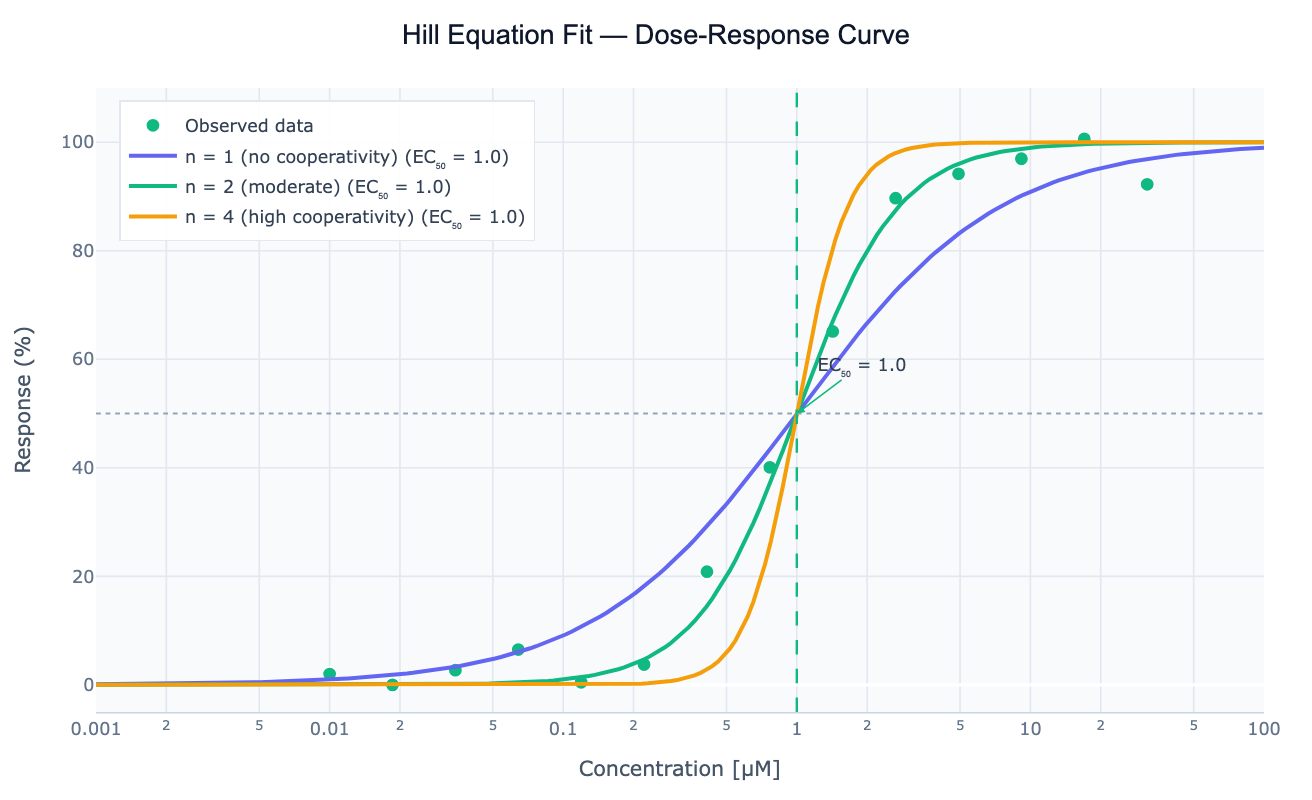
The Hill equation is a sigmoidal mathematical model that describes how a response variable — enzyme activity, receptor occupancy, drug effect, fluorescence signal — saturates as stimulus concentration increases. It takes the form Response = Emax × Cⁿ / (EC50ⁿ + Cⁿ), where Emax is the maximum response, EC50 (or IC50 for inhibition) is the concentration at half-maximal effect, and n is the Hill coefficient that controls the steepness of the sigmoid. When n = 1 the curve reduces to simple Michaelis-Menten hyperbolic saturation; when n > 1 the curve is steeper (cooperative binding or steep dose-response); when n < 1 it is shallower (negative cooperativity or heterogeneous binding sites).
The Hill coefficient was first derived to describe the cooperative binding of oxygen to hemoglobin (n ≈ 2.8) — where binding of one oxygen molecule increases the affinity for subsequent molecules. Today the Hill equation is the standard model for IC50 determination in drug discovery (what concentration inhibits 50% of activity?), EC50 determination in pharmacology (what concentration produces 50% of the maximum effect?), activation curves in neuroscience (action potential gating), and binding curves in biochemistry (ligand-receptor or ligand-DNA interactions). The parameters are extracted by nonlinear least-squares fitting using the Levenberg-Marquardt algorithm.
How It Works
- Upload your data — provide a CSV or Excel file with a concentration column (numeric, any units) and a response column (numeric: percent inhibition, fluorescence, activity, occupancy). Optional: a group or replicate column for multiple curves.
- Describe the analysis — e.g. "fit Hill equation to columns 'concentration_uM' and 'inhibition_pct'; extract IC50, Hill coefficient, and Emax with 95% confidence intervals; plot on log scale"
- Get full results — the AI writes Python code using scipy.optimize.curve_fit to fit the Hill equation and Plotly to render the sigmoidal curve with data points and confidence bands
Required Data Format
| Column | Description | Example |
|---|---|---|
concentration | Stimulus or drug concentration (any unit) | 0.01, 0.1, 1.0, 10 (µM) |
response | Measured effect | 5, 28, 51, 89 (%) |
group | Optional: compound or condition label | Drug A, Drug B |
Any column names work — describe them in your prompt.
Interpreting the Results
| Parameter | What it means |
|---|---|
| EC50 / IC50 | Concentration producing 50% of maximum effect — the primary potency measure |
| Emax | Maximum response asymptote — 100% for normalized data, actual maximum for raw data |
| Hill coefficient (n) | Sigmoidal steepness: n=1 (simple hyperbolic), n>1 (cooperative/steep), n<1 (shallow) |
| 95% CI on EC50 | Precision of the potency estimate — narrower CI = better-constrained fit |
| R² | Goodness of fit — values > 0.99 are typical for clean dose-response data |
| Residual plot | Check for systematic pattern — random scatter confirms model is appropriate |
| Steep sigmoid (large n) | Cooperative system or a threshold-like switch |
| Flat sigmoid (small n) | Heterogeneous binding sites or measurement at narrow concentration range |
Example Prompts
| Scenario | What to type |
|---|---|
| Basic fit | fit Hill equation, concentration column is 'dose_uM', response is 'inhibition_pct'; report IC50 with 95% CI |
| Multiple compounds | fit Hill curves for each compound in the 'drug' column; overlay on one plot; rank by IC50 |
| Cooperative binding | Hill equation fit with Hill coefficient; annotate EC50 and n; is n significantly different from 1? |
| Log-scale plot | sigmoidal dose-response fit on log10 concentration axis; add EC50 and 90% effect markers |
| Normalized data | normalize response 0–100% then fit Hill equation; report EC50, n, and goodness of fit |
| Inhibition with baseline | fit 4-parameter Hill (bottom, top, IC50, n); concentrations 0.001–100 µM |
Assumptions to Check
- Monotone response — the Hill equation assumes response strictly increases (or decreases) with concentration; non-monotone data (e.g. bell-shaped) requires a different model
- Wide enough concentration range — the dataset should span from near-baseline to near-Emax; fitting only the steep middle region cannot reliably estimate EC50 or Emax
- Replicate measurements — single measurements at each concentration have no internal error estimate; include at least n=3 technical replicates per concentration
- Appropriate baseline — if the response does not start near 0 at low concentrations (e.g. partial agonist with non-zero floor), use the 4-parameter Hill equation with a free bottom parameter
- Independence — if the same sample is remeasured, observations are not independent; treat as technical replicates, not independent data points
Related Tools
Use the Michaelis-Menten Fit when your data follows a simple hyperbolic (non-sigmoidal) saturation model — enzyme velocity vs. substrate concentration without cooperativity. Use the Lineweaver-Burk Plot to linearize enzyme kinetics data and identify inhibition type. Use the Logistic Regression tool when your outcome is binary (event/no event) rather than a continuous graded response.
Frequently Asked Questions
What is the difference between EC50 and IC50?EC50 (half-maximal effective concentration) applies to activation assays — the concentration that produces 50% of the maximum stimulation (e.g. receptor agonists, enzyme activators). IC50 (half-maximal inhibitory concentration) applies to inhibition assays — the concentration that reduces activity by 50% (e.g. enzyme inhibitors, cytotoxicity, viral plaque reduction). Both are extracted identically from a Hill equation fit; the naming just reflects the direction of the effect.
My Hill coefficient is much greater than 1 — is that biologically meaningful? A Hill coefficient n > 1 indicates positive cooperativity — binding of the first ligand increases affinity for subsequent ones. Classic example: hemoglobin (n ≈ 2.8). However, in pharmacological dose-response curves, n > 2 often reflects a steep but not mechanistically cooperative response — the Hill coefficient then serves as an empirical steepness descriptor rather than a literal measure of binding sites.
How do I compare IC50 values across compounds statistically? Fit each compound's curve independently to get IC50 and its standard error, then compare with a t-test on log(IC50) values (since IC50 follows a log-normal distribution). Alternatively, fit all curves simultaneously in a global model and test whether the IC50 parameters are equal. Ask the AI to "fit Hill curves for each compound and report IC50 with 95% CI for pairwise comparison".
What is the 4-parameter Hill equation and when do I need it? The standard (3-parameter) Hill equation assumes the response starts at exactly 0 at zero concentration and reaches exactly Emax at high concentration. The 4-parameter logistic (4PL) adds a free bottom parameter: Response = Bottom + (Top − Bottom) × Cⁿ / (EC50ⁿ + Cⁿ). Use 4PL when your data has a non-zero baseline (e.g. partial agonist, background fluorescence) or does not reach 100% inhibition.
My curve looks sigmoidal but R² is low — what is wrong? Low R² with a visually good fit usually indicates high measurement noise or only 1–2 replicates. Check the residual plot — if residuals are random and small relative to the response range, the fit is fine despite low R². Low R² with a systematic residual pattern (S-shaped residuals) means the Hill equation is the wrong model — try a biphasic Hill equation or a Gaussian peak model.