Inequality Solver
Solve linear and quadratic inequalities online with AI. Get interval notation, number line logic, and worked steps.
Preview
What Is a Math Inequality?
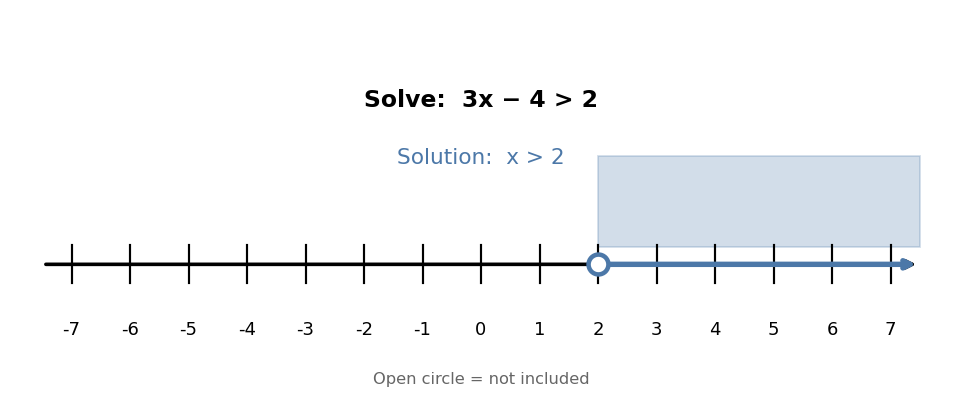
An inequality expresses that one expression is greater than, less than, or not equal to another. Unlike an equation with a single solution, an inequality typically has an infinite set of solutions — a range of values that satisfy the condition.
This tool solves single-variable and multi-variable inequalities step by step, and presents solutions in interval notation, set notation, or on a number line.
Types of Inequalities Supported
Linear inequalities
3x - 5 > 7→ find all x satisfying the condition2(x + 1) ≤ 3x - 4
Compound inequalities
-3 < 2x + 1 ≤ 9(and-type: both conditions must hold)x < -2 or x > 5(or-type: either condition holds)
Quadratic inequalities
x² - 5x + 6 < 0→ find where the parabola is below the x-axis2x² + 3x - 2 ≥ 0
Rational inequalities
(x + 1)/(x - 3) > 0→ requires checking sign changes at critical points
Absolute value inequalities
|2x - 3| < 5→ split into two cases|x + 1| ≥ 4
Systems of inequalities
y > 2x + 1 and y ≤ -x + 4→ find the feasible region
How It Works
- Type the inequality — use standard notation:
>,<,>=,<=, or≥,≤ - Get step-by-step working — the AI shows each algebraic step and explains the logic (e.g. flipping the sign when multiplying by a negative)
- Solution expressed clearly — in interval notation (e.g.
(-∞, 4]), set notation, or described in plain English
Example Problems
| Type | Example |
|---|---|
| Linear | 5x + 3 ≥ 2x - 9 |
| Compound | -4 < 3x - 1 < 8 |
| Quadratic | x² - 4x - 5 < 0 |
| Absolute value | |3x + 2| > 7 |
| Rational | (2x - 1)/(x + 3) ≤ 0 |
Frequently Asked Questions
Why does the inequality sign flip? When you multiply or divide both sides by a negative number, the direction of the inequality reverses. The AI will explicitly call this out in the working.
What is interval notation?
Interval notation compactly represents a range of values. For example, [2, 5) means all x where 2 ≤ x < 5. Square brackets [ ] include the endpoint; parentheses ( ) exclude it.
Can it solve inequalities with two variables?
Yes — for two-variable inequalities (e.g. y > 2x + 1), the AI will describe or plot the solution region.
What if my inequality has no solution?
The AI will identify when the solution set is empty (e.g. x > 5 and x < 2) and explain why.