Datasets 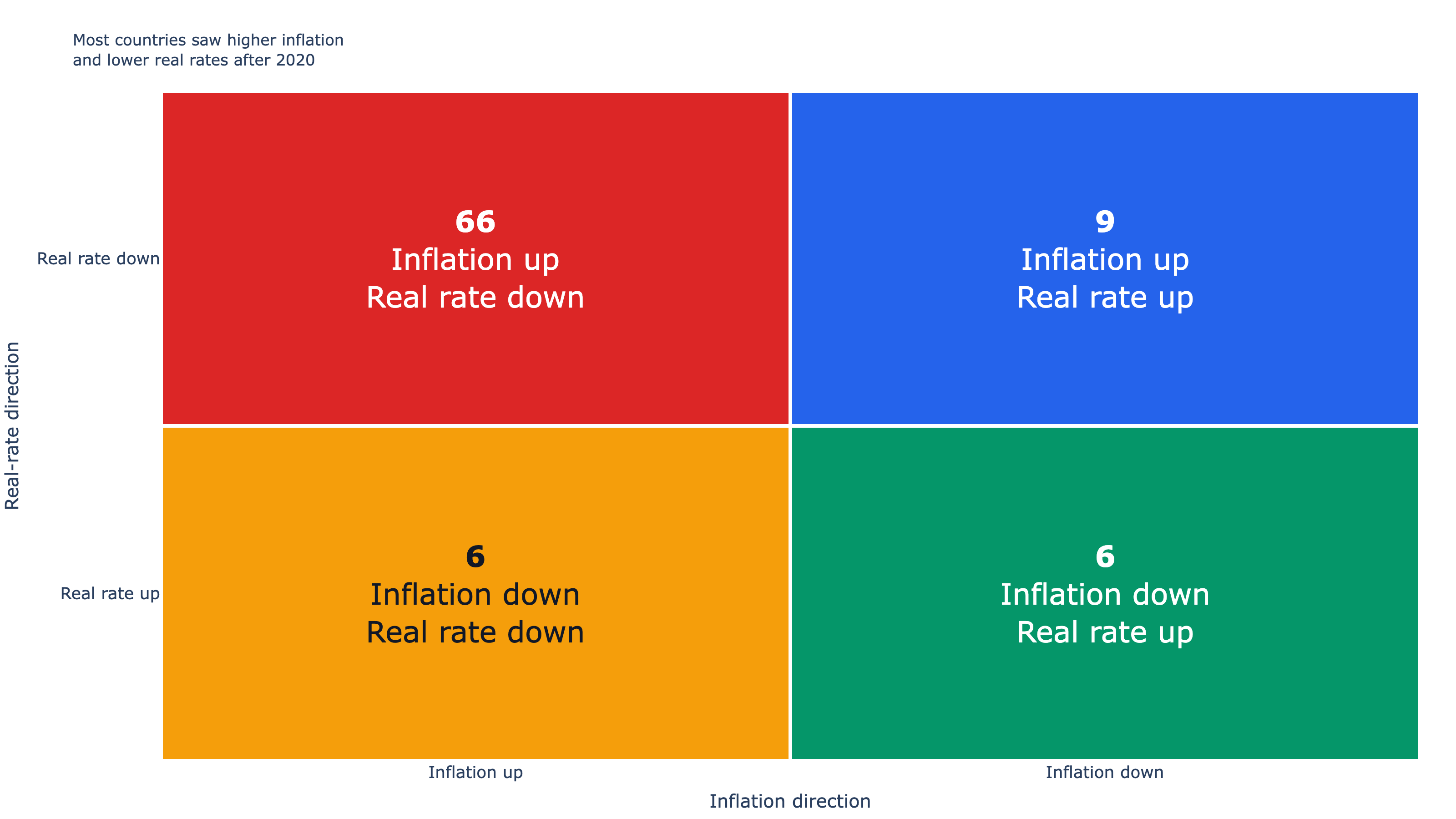
Inflation surged in 87 countries after 2020 — real borrowing costs barely budged
In three out of four countries, inflation rose while real interest rates fell. The few exceptions tell an interesting story.
Datasets Used
Inflation, consumer prices (annual %)
World Bank. "Inflation, consumer prices (annual %)" [dataset].
Real interest rate (%)
World Bank. "Real interest rate (%)" [dataset].
Inflation rose sharply across most of the world after 2020. But did borrowing actually get more expensive? In most countries, the answer is no. Real interest rates — what borrowers pay after adjusting for inflation — fell even as prices climbed.

This analysis compares average inflation and real interest rates before the pandemic (2015-2019) and after it (2021-2024) using World Bank data for 87 countries with sufficient observations in both windows.
## Three out of four countries landed in the same quadrant

The 2x2 below sorts every country in the sample by what happened to inflation and real rates after 2020. The red quadrant — inflation up, real rates down — dominates. The blue quadrant, where real rates actually tightened alongside rising inflation, is the smallest group.
## The biggest inflation surges came with the weakest real-rate responses

Countries that saw the largest jumps in inflation tended to see real rates weaken, not strengthen. The scatter below makes the negative relationship visible: the further right a country sits (bigger inflation increase), the more likely it is below the zero line (real rates fell).
The table below lists the 12 countries with the largest inflation jumps. In nearly every case, real rates moved in the opposite direction.
## A handful of countries did tighten real borrowing costs

Not every country followed the dominant pattern. A smaller group saw inflation rise but still maintained positive real rates in the 2021-2024 window — meaning borrowers genuinely faced tighter conditions despite the inflationary environment.
## The global pattern points to a borrower-friendly era — for now

The dominant story across 87 countries is clear: inflation rose after 2020, but real borrowing costs mostly didn't. In three-quarters of the sample, borrowers were effectively paying less in inflation-adjusted terms even as headline prices climbed.

That has consequences. Low real rates can fuel asset prices and borrowing, but they also mean savers and fixed-income earners are losing purchasing power. Whether this pattern persists depends on how aggressively central banks respond as inflation moderates — or whether they declare victory too early.
Chat With This Data
Ask a question and Keptune will open a new chat with this page’s datasets already attached.
0/2 images ·0/5000