Datasets 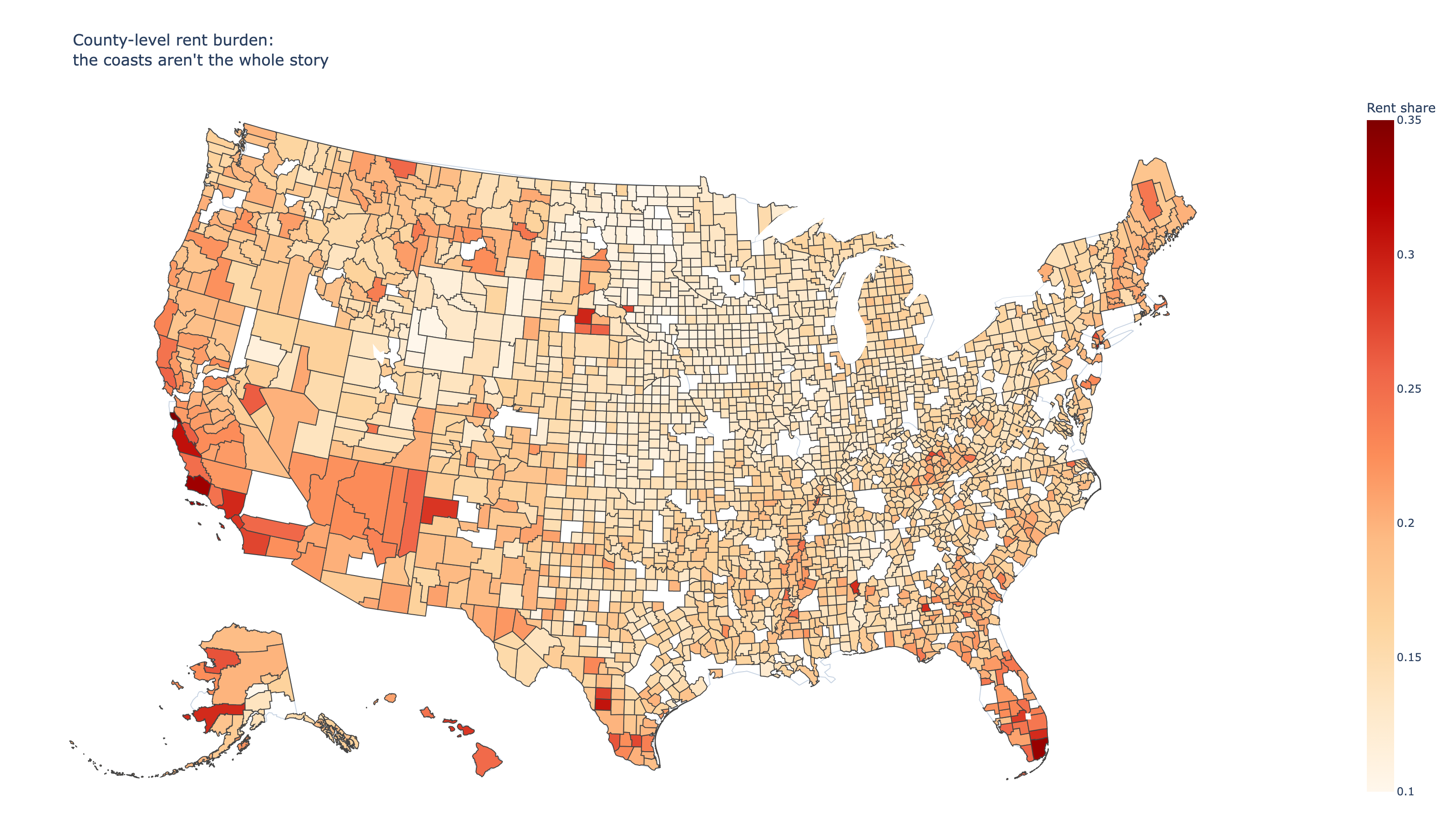
The least affordable U.S. counties aren't the ones you'd guess
HUD data shows Santa Cruz, Miami-Dade, and rural pockets ask more of median incomes than most people realize. The usual suspects aren't always on top.
Datasets Used
Fair Market Rents by County, FY 2026
U.S. Department of Housing and Urban Development. Fair Market Rents, Fiscal Year 2026.
Section 8 Income Limits by County, FY 2025
U.S. Department of Housing and Urban Development. Section 8 Income Limits, Fiscal Year 2025.
New York and San Francisco are expensive — everyone knows that. But when you measure rent against what local households actually earn, a different set of places rises to the top. Some of the least affordable counties in the U.S. are not coastal luxury markets at all.

This analysis pairs HUD's FY 2026 Fair Market Rents with FY 2025 median family income estimates to compute a simple affordability ratio: how much of a local median income goes to a 2-bedroom apartment at the fair market rate.
## California and the New York metro dominate — but look who else is on the list

The top of the ranking mixes high-cost coastal metros with places you might not expect. Miami-Dade sits alongside Santa Cruz. Rural counties in Texas, South Dakota, and New Mexico appear because their incomes are low enough to make even modest rents burdensome.
That first chart reveals something important: the least affordable places are not just "expensive cities." They include rural and tribal counties where incomes are low enough that even a sub-$1,000 rent consumes a large share of household income.

## The state-level map shows a coastal squeeze — and a few inland surprises

When you take the median rent burden across all counties in each state, the familiar coastal pattern emerges. But Montana, New Hampshire, and Maine also show up, reflecting how quickly rents have risen in those states relative to local incomes.
## Zoom in to counties and the hotspots sharpen

The state map smooths over enormous local variation. When you color every county by its rent-to-income ratio, the picture sharpens: deep-red pockets appear not just on the coasts but in tribal lands, the Texas border, and parts of Appalachia.
## The scatter shows two kinds of unaffordable: high-rent and low-income

There are two paths to a high rent burden. One is having very high rents (Santa Cruz, NYC). The other is having very low incomes (rural counties in the South and Great Plains). The scatter plot below separates the two.
## The most affordable counties are in the Great Plains and Midwest

At the other end, the cheapest places to rent relative to local incomes are overwhelmingly in states with strong energy or agricultural economies — North Dakota, Texas, Kansas — where incomes are high and rents have stayed contained.
## Affordability isn't just a coastal problem — it's a income problem

The usual narrative frames housing affordability as a supply story in expensive metros. That's part of it. But the county-level data reveals a second, less-discussed pattern: places where rents are modest in absolute terms but incomes are too low to make even those rents manageable.

That has different policy implications. Building more housing helps in Santa Cruz and Miami. But in Oglala Lakota County or rural New Mexico, the constraint is income, not supply. Treating all affordability problems with the same toolkit misses the distinction the data makes clear.
Chat With This Data
Ask a question and Keptune will open a new chat with this page’s datasets already attached.
0/2 images ·0/5000