Datasets 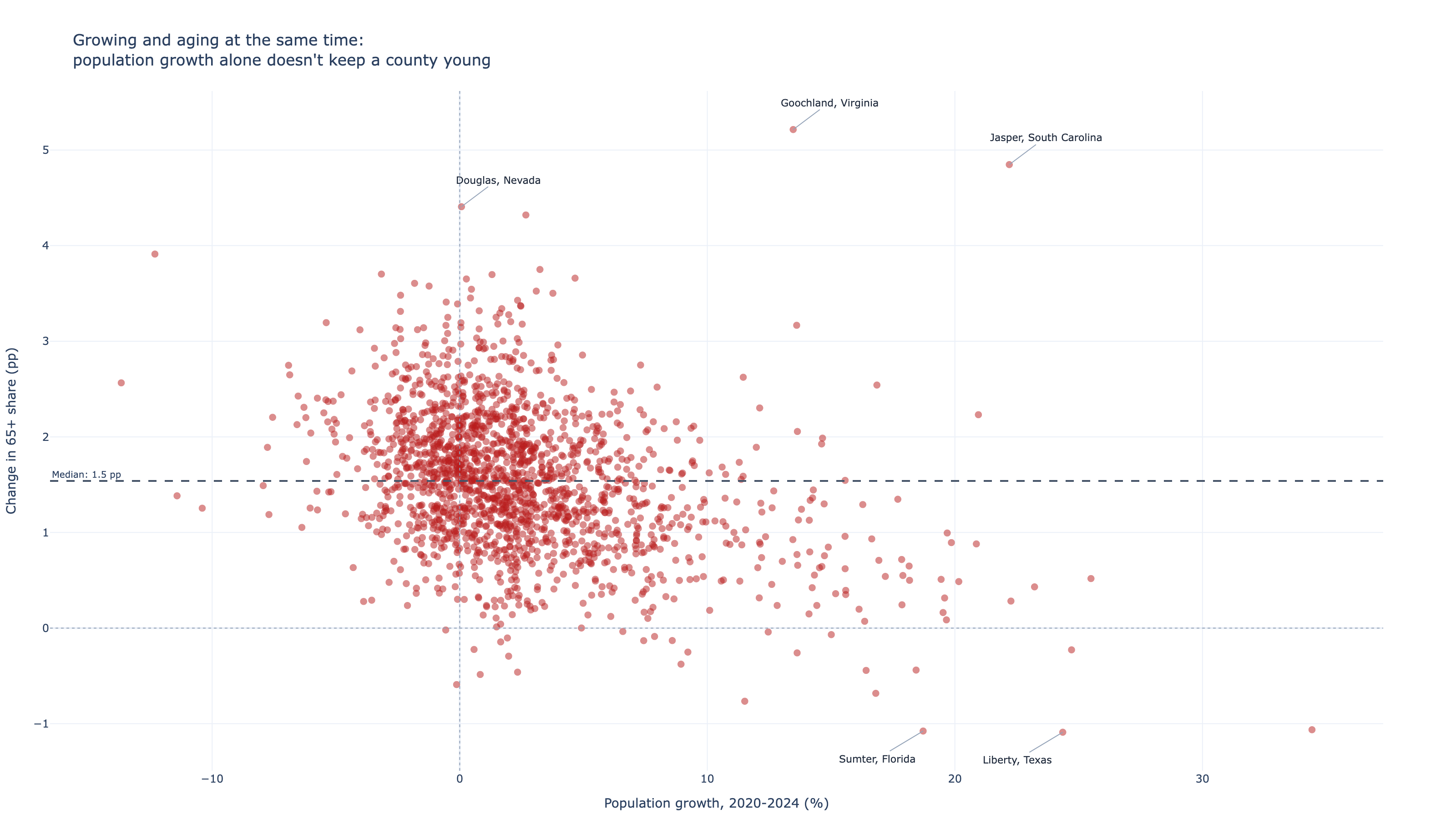
Where America Is Aging Fastest — and the Surprising Places Getting Younger
Most U.S. counties got older between 2020 and 2024, but the reasons vary wildly. Retiree magnets, shrinking towns, and booming exurbs are all reshaping the age map in different ways.
Datasets Used
County Population by Characteristics: 2020-2024 (Age, Sex, Race, Hispanic Origin)
U.S. Census Bureau, Population Estimates Program (PEP). County Population by Characteristics: 2020-2024.
Everyone knows America is getting older. But the county-level picture is far stranger than the national average suggests. In some places, retirees are flooding in and tipping the age balance. In others, young people are leaving and no one is replacing them. And in a handful of fast-growing counties, the opposite is happening: families are arriving quickly enough to make the population *younger*.

This analysis uses Census Population Estimates for 2020 and 2024 to track how the share of residents age 65+ shifted across every sizable U.S. county (at least 20,000 residents in both years).
## Population growth doesn't prevent aging — and sometimes accelerates it

The scatter plot below makes the key surprise visible. Counties in the upper-right quadrant are both *growing* and *aging* — retirees are moving in faster than young families. Counties in the upper-left are the more intuitive story: shrinking places where the young have left. And the handful below the zero line? Those are the rare places actually getting younger.
Notice how many dots sit in the upper-right quadrant — growing *and* aging simultaneously. These are often retirement magnets where new arrivals skew older. The conventional wisdom that aging equals decline misses this entire category.

## Which counties aged the fastest?

The top 12 include well-known retirement corridors, but also places you might not expect — counties where the young-adult pipeline simply thinned out even as total population held steady.
## The rare counties actually getting younger

Only a handful of sizable counties saw their 65+ share *fall* between 2020 and 2024. Almost all of them were booming exurbs in Texas and Florida drawing young families — not struggling cities staging a demographic comeback.
## The takeaway

"America is aging" is true but misleading. At the county level, at least three distinct forces are at work: retirees concentrating in amenity-rich areas, young adults draining out of rural and post-industrial counties, and a small number of exurban boomtowns growing young and fast. Each dynamic carries different implications for housing, healthcare, and tax base — and they are happening simultaneously, often just a few counties apart.
Chat With This Data
Ask a question and Keptune will open a new chat with this page’s datasets already attached.
0/2 images ·0/5000